
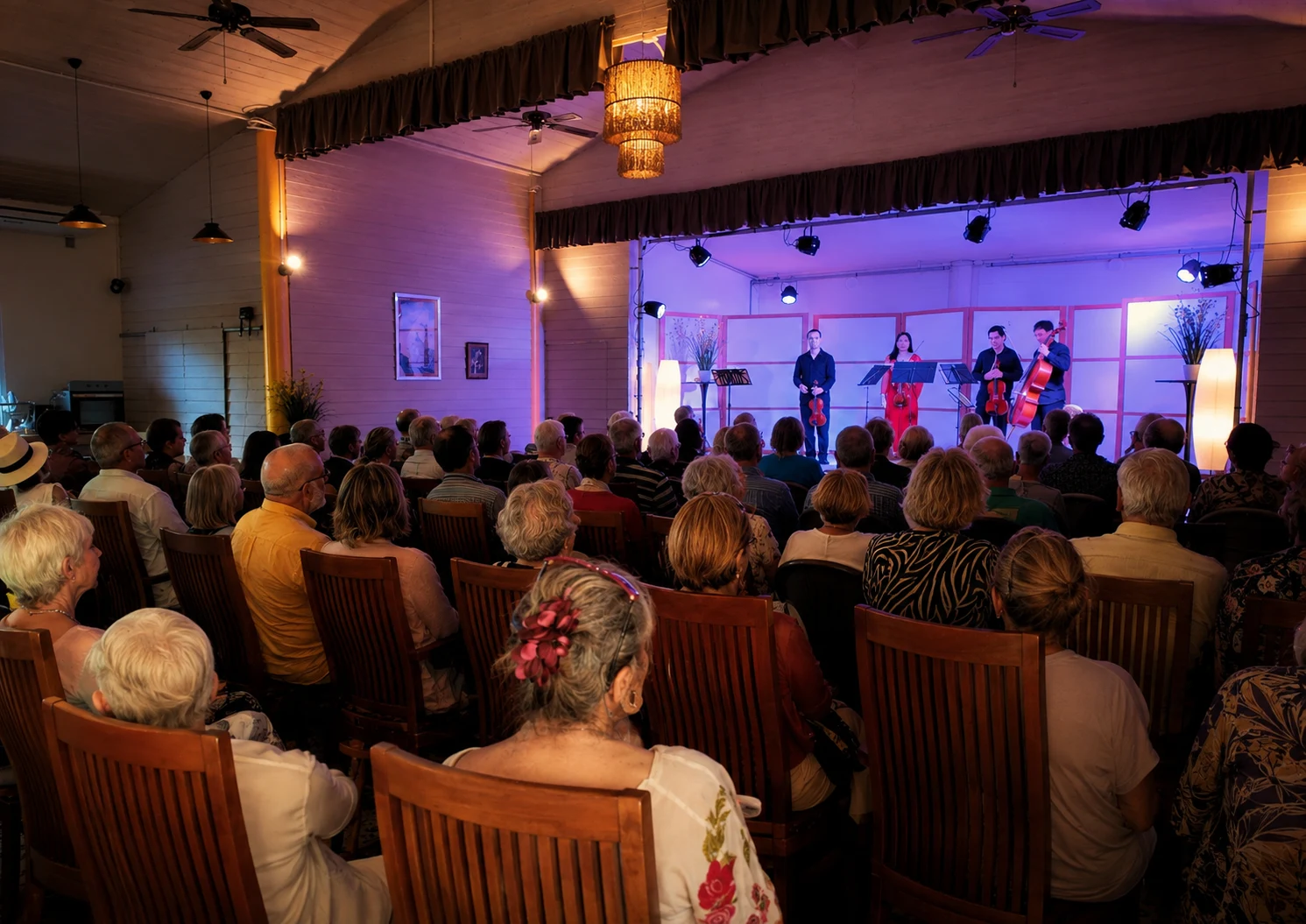
The Beautiful Miller’s Daughter
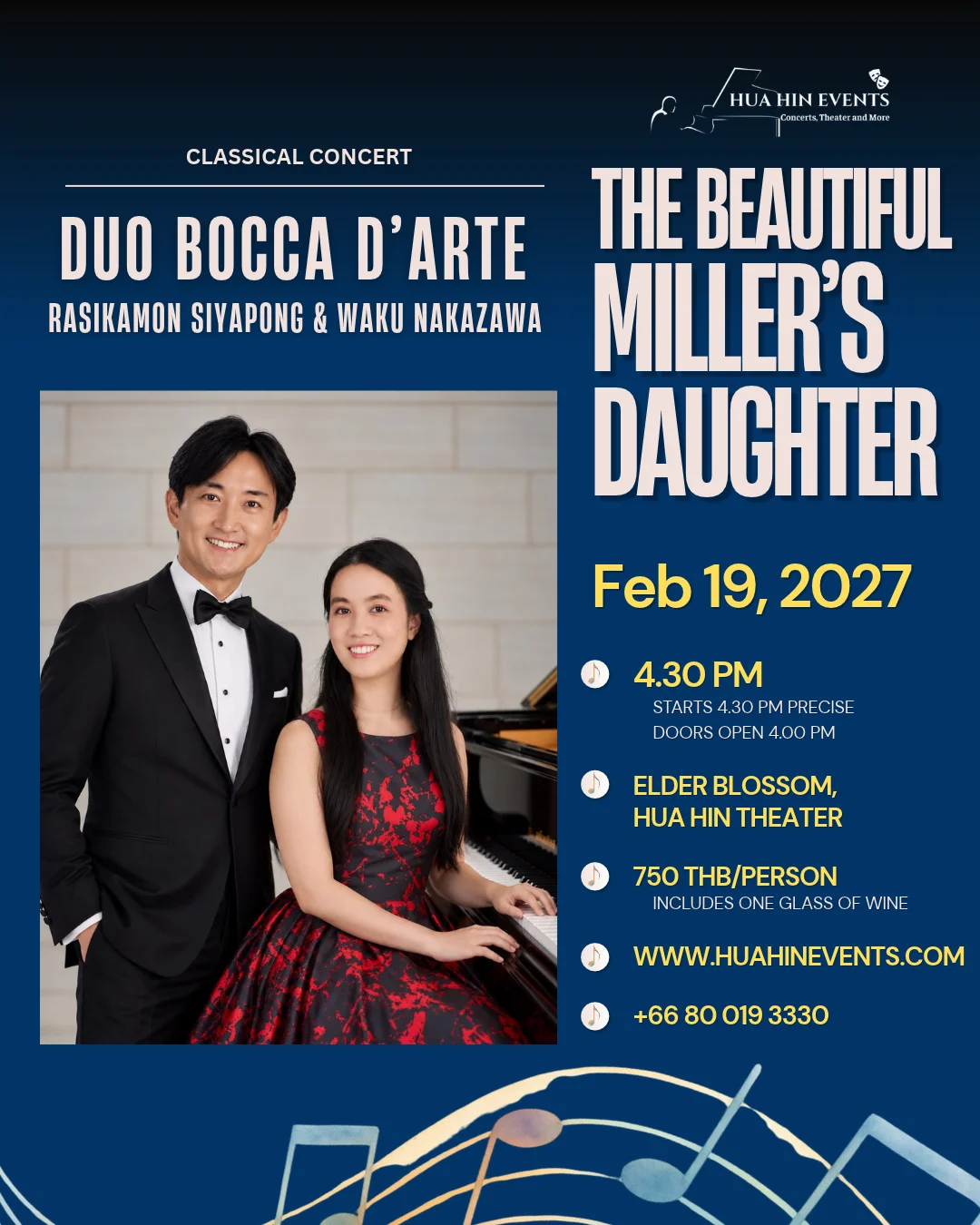
Experience an intimate afternoon of classical music with The Beautiful Miller’s Daughter, featuring Franz Schubert’s Die schöne Müllerin, performed by Duo Bocca d’Arte — Waku Nakazawa (tenor) and Rasikamon Siyapong (piano)— at Elder Blossom, Hua Hin.
Composed in 1823, Die schöne Müllerin is celebrated as one of the great masterpieces of the Romantic song cycle. Based on poetry by Wilhelm Müller, the work follows a young miller whose journey begins with hope and the excitement of new love, before gradually becoming a story of jealousy, heartbreak and despair. The poetry originally emerged from a drawing-room game among young intellectuals in Berlin, but Schubert transformed the story into a deeply emotional musical experience.
Schubert composed the work during a difficult period in his own life, when he was struggling with serious illness. Against this personal background, the music explores isolation, vulnerability and the painful uncertainty of love, creating an emotional world that extends far beyond the story's simple setting.
At the heart of the narrative is the brook (Der Bach), which becomes much more than a part of the landscape. It serves as the young miller's companion and confidant, reflecting his changing emotions as the story unfolds. Through flowing musical patterns, the piano brings the movement of water to life, from gentle ripples of happiness to moments of tension and uncertainty.
One of the most distinctive elements of the composition is the piano's role as an active storyteller. Rather than simply accompanying the singer, it helps reveal emotions that the character may not express in words. Schubert uses changes in melody, rhythm and harmony, together with the contrast between major and minor keys, to portray the young miller's shifting state of mind. The piano's flowing water patterns also give way to energetic rhythms associated with the rival hunter, bringing a new sense of tension to the story.
Colour symbolism adds another layer of meaning. White represents the young miller's innocence, while green becomes associated with the rival hunter, jealousy and emotional suffering. In songs such as Die böse Farbe and Trockne Blumen, these feelings become especially powerful, revealing the tragic direction of the young man's journey.
Bringing this remarkable work to the stage is Duo Bocca d’Arte, featuring Japanese tenor Waku Nakazawa and Thai pianist Rasikamon Siyapong. Nakazawa brings nearly two decades of musical experience in Austria, including his study of the German Lied tradition with distinguished artists. Rasikamon, an experienced collaborative pianist and chamber musician, has performed extensively with vocalists and instrumentalists across Europe and Asia. Together, they explore the close relationship between voice, piano and poetry that makes Schubert's music so expressive.
Join us at Elder Blossom, Hua Hin, for an afternoon of classical music exploring love, longing, hope and loss, where a timeless story comes to life through the expressive power of voice and piano.
Neem voor meer informatie contact met ons op
Toegangsprijs:
฿ 750
Inclusief een glas wijn
Datum & Tijd:
vrijdag 19 februari 2027
16:30
Organisator:
Hua Hin Events
Adres:
476 Moo 1 Soi Porn Sawan, Hin Lek Fai, Hua Hin, Prachuap Khiri Khan 77110, Thailand
Locatie:
Programma
Franz Schubert — Die schöne Müllerin (1823)
Song Cycle for Tenor and Piano
Poetry by Wilhelm Müller
Die schöne Müllerin is a celebrated work of the Romantic song-cycle tradition, combining poetry and music to tell the emotional story of a young miller whose hopes of love gradually turn into jealousy, heartbreak and despair.
The Story Behind the Music
From a Drawing-Room Game to a Romantic Masterpiece
The poetry by Wilhelm Müller originally emerged from a drawing-room game among young intellectuals in Berlin. What began as a lighthearted dramatic story was transformed by Schubert into a deeply expressive musical work exploring love, longing and emotional suffering.
The Brook — Der Bach
The brook is one of the central elements of the story. Through flowing musical patterns, the piano captures the sound and movement of water, allowing it to reflect the young miller's changing emotions.
The Piano as a Storyteller
Schubert gives the piano an active role in the narrative. Rather than simply supporting the singer, the piano reveals emotions, creates atmosphere and helps portray the young miller's changing state of mind.
Musical Highlights
1. Schubert — Das Wandern
The opening song reflects the young miller's journey and his connection with nature. Its recurring musical structure creates a sense of movement, simplicity and youthful optimism.
2. Schubert — Die böse Farbe (The Hateful Color)
The colour green becomes a symbol of jealousy and emotional suffering, revealing the young miller's growing distress.
3. Schubert — Trockne Blumen (Withered Flowers)
One of the most emotionally powerful moments in the cycle, this song explores the young miller's thoughts of death. Schubert's shift from minor to major harmony creates a striking contrast between sorrow and imagined hope.
Musical Expression
Throughout the work, Schubert uses recurring and continuously developing musical forms, changes in rhythm and harmony, and the contrast between major and minor keys to express the young miller's emotional journey.
Together, voice and piano create an intimate musical drama that brings poetry, nature and human emotion to life.
Met Medewerking Van

Waku Nakazawa
Tenor / Vocalist
Born in Tokyo, Japanese tenor Waku Nakazawa graduated with a Bachelor’s degree in Voice Performance from Kunitachi College of Music before continuing his studies in Austria. In 2008, he graduated with distinction in Voice Performancefrom the Vorarlberger Landeskonservatorium in Feldkirch. He subsequently continued his studies at Mozarteum University Salzburg, focusing on Opera, Musical Theatre, Lied and Oratorio.
Over nearly two decades in Austria, Nakazawa developed an extensive career in opera, concert and Lied. Since 2009, he has performed regularly at the Oper im Berg Festival in Salzburg, where his roles have included Tamino, Monostatos and the First Armoured Man in Mozart’s Die Zauberflöte, as well as Belmonte in Die Entführung aus dem Serail. In 2011, he received the Scholarship Prize at the Grandi Voci singing competition in Salzburg.
Lied has been an important part of Nakazawa’s artistic development. During his years in Austria, he studied with and received guidance from distinguished artists including Kurt Widmer, Wolfgang Holzmair, Barbara Bonney and Peter Schreier. His repertoire includes Beethoven’s An die ferne Geliebte, Schubert’s Winterreise and Schumann’s Dichterliebe.
Nakazawa is also an experienced conductor. Since 2014, he has conducted more than ten major opera productions across Austria, Germany and Denmark. He is particularly known as a “Conductenor”, combining conducting and singing within the same production. In 2024, he conducted Verdi’s Rigoletto in Bangkok.
In Thailand, Nakazawa has appeared as a guest soloist with orchestras including the Thailand Philharmonic Orchestra, Bangkok Metropolitan Orchestra, Mahidol Symphony Orchestra, Immanuel Orchestra and Chiang Rai Youth Orchestra.
He is currently a Voice Instructor at the College of Music, Mahidol University.
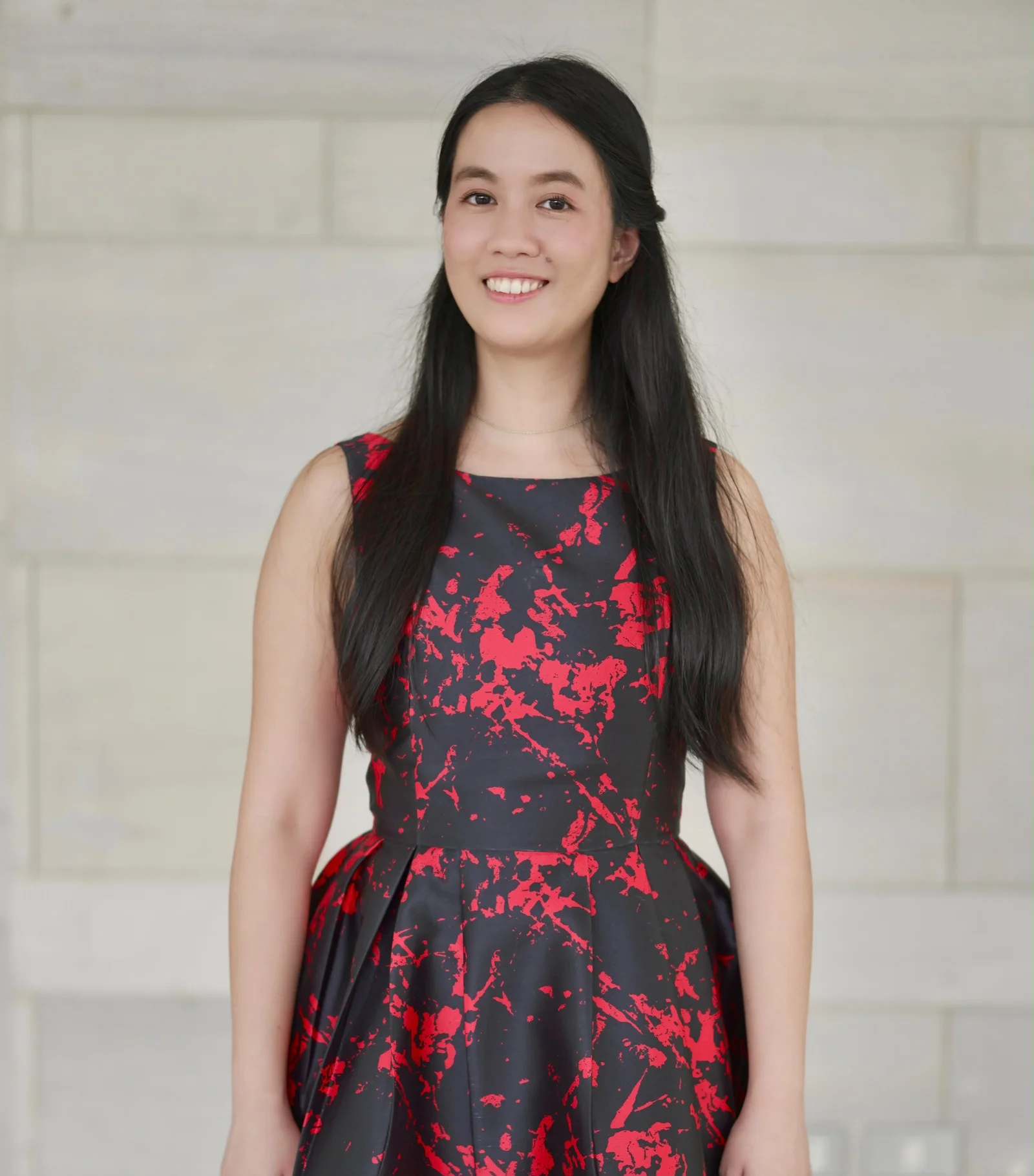
Rasikamon Siyapong
Piano
Rasikamon Siyapong is one of Thailand’s most sought-after collaborative pianists and chamber musicians, having performed extensively with vocalists and instrumentalists throughout Europe and Asia.
She has appeared at numerous international music festivals and competitions, including the Jean-Marie Londeix Competition, Beethoven Competition for String Instruments in Bangkok, Summer Festival for String Instruments and Chamber Music in Pelion, and Asia Pacific Saxophone Academy.
She has collaborated with leading international vocalists and performed in European cities including Munich, Graz, Vienna, Salzburg, Athens and Maribor. In 2018, her performance with soprano Tung Lee was broadcast on Austrian Radio through the programme Das Ö1 Konzert.
An active performer of contemporary music, Rasikamon regularly participates in the Thailand International Composition Festival and is a member of Contemporary Enclave, a Bangkok-based ensemble dedicated to promoting contemporary music.
In 2014, she graduated with first-class honours in Piano Performance from the College of Music, Mahidol University. She also received an ASEA-Uninet scholarship and studied at Mozarteum University as an exchange student.
In 2019, she completed her Master’s degree in Vocal Accompaniment at the University of Music and Performing Arts Graz, Austria, studying under Stacey Bartsch and Julius Drake.
Since 2019, she has been a faculty member at Mahidol University, where she also serves as a collaborative pianist.
LET OP:Reservering is verplicht en mogelijk tot vrijdag 19 februari 2027 at 04:30 PM
U kunt zich nog aanmelden:
Reserveer Uw Zitplaatsen
Rond uw boeking af op onze betaalpagina. Controleer de evenementgegevens, namen en het totaal voordat u online betaalt of betaling aan de deur kiest.
Verder naar afrekenenMet dank aan onze officiële sponsor: